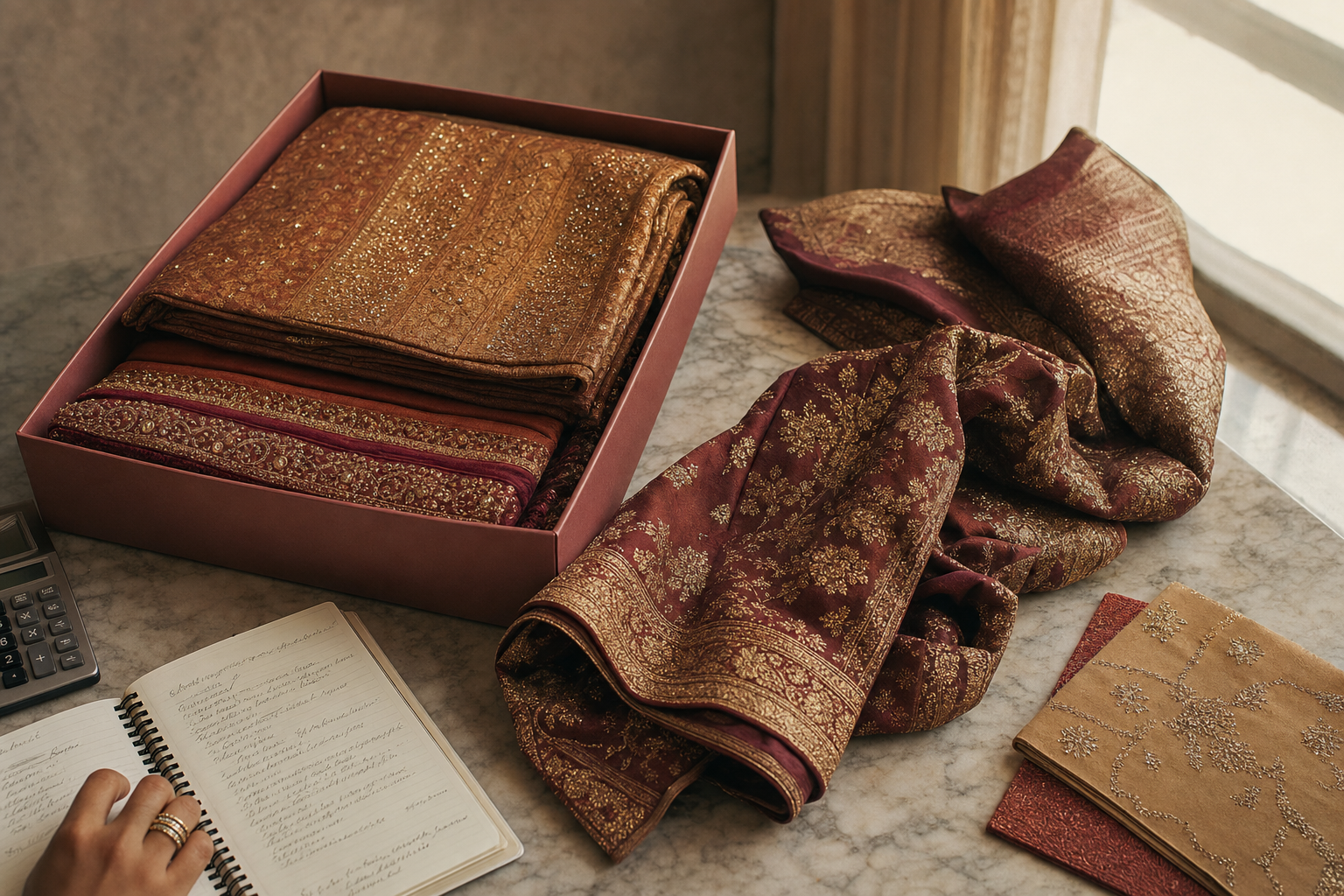
Every Indian D2C womenswear founder I have spoken to in the last eighteen months has the same Diwali story.
They tell it differently — some in numbers, some in PR-laundered euphemism, some in the exhausted half-laugh that founders use for losses they have already metabolised. The structure is identical. We over-bought what nobody wanted. We under-bought what walked out the door in a week. We spent the markdown season fixing it. Next year will be different.
Next year is not different. The reason is not lack of intelligence on the buying floor. It is that the forecasting tool the buying floor uses cannot see the calendar.
The maths is not the problem
Off-the-shelf demand forecasting is a mature discipline. Ensemble forecasting — combining a baseline trend, seasonal cycles, and a handful of contextual covariates — has been a solved problem since the 1990s. Any competent statistician can produce a 12-week forecast for a SKU with twelve months of clean sales data and a back-of-envelope confidence interval.
The trouble is that off-the-shelf forecasting assumes a continuous calendar. Demand on December 19 is roughly demand on December 12 plus a small amount of trend. Demand on October 24 — the Friday before Karva Chauth in 2025 — is eight times the demand on October 17 for the same SKU class. No continuous-calendar model survives that step function.
You cannot smooth your way out of a multiplier. You can only model it.
What actually happens in a brand under ₹200 crore
Let me describe the process, because the polite version on conference panels does not match the spreadsheet I have seen in twenty buying rooms.
A senior buyer, working alone or with one assistant, looks at last year's festive numbers in a Google Sheet. She adjusts upward by an instinct multiplier — last year was OK so let's do 1.4x; last year was bad so let's hold at 1.1x — and writes the PO. The PO goes to the manufacturer. The manufacturer, in Surat or Jaipur or Tirupur, has its own queue of festive orders from forty other brands. The buyer prays.
Three things go wrong, every year, in every brand I have seen.
One. The buy goes in too late. Chanderi from Madhya Pradesh has a fourteen-week lead time at festive volume — twelve weeks of weaving and two of finishing and ship. If you are placing the order in August for Diwali in late October, you are already three weeks behind the curve. The order arrives at Diwali week, sells through in five days, and the reorder is impossible because the loom is already weaving for next season.
Two. The buy is too shallow on the right SKUs and too deep on the wrong ones. The buyer's instinct multiplier is applied uniformly across the festive capsule. But festive demand is not uniform. The cobalt anarkali in 2024 outsold the marigold anarkali six-to-one in the same brand, because cobalt was the Sabyasachi colour for that season and the Indian wedding-guest market had decided. No spreadsheet model that treats anarkali as one SKU class catches that.
Three. The depth calculation ignores the cost of the wrong answer. Most buyers think about depth as a single number — how many units of this style do we make — and they pick the number that minimises their personal stockout regret. They do not think about the asymmetric cost of being wrong in either direction. Stockout cost is the gross margin on the lost sale. Holding cost is the markdown plus the carrying interest. For a high-margin festive SKU these two numbers can differ by a factor of four. Buyers who treat the two costs as symmetric will systematically under-buy the high-margin pieces and over-buy the low-margin ones.
“You cannot smooth your way out of a multiplier. You can only model it.
”
What we built, in three sentences
We built TrendSense because the right tool for this problem is not a better spreadsheet. It is a forecast that knows about the festive calendar as a first-class object, that sizes depth-of-buy against the asymmetric cost of being wrong, and that talks to the buyer in the language of the buying floor instead of the language of the data scientist.
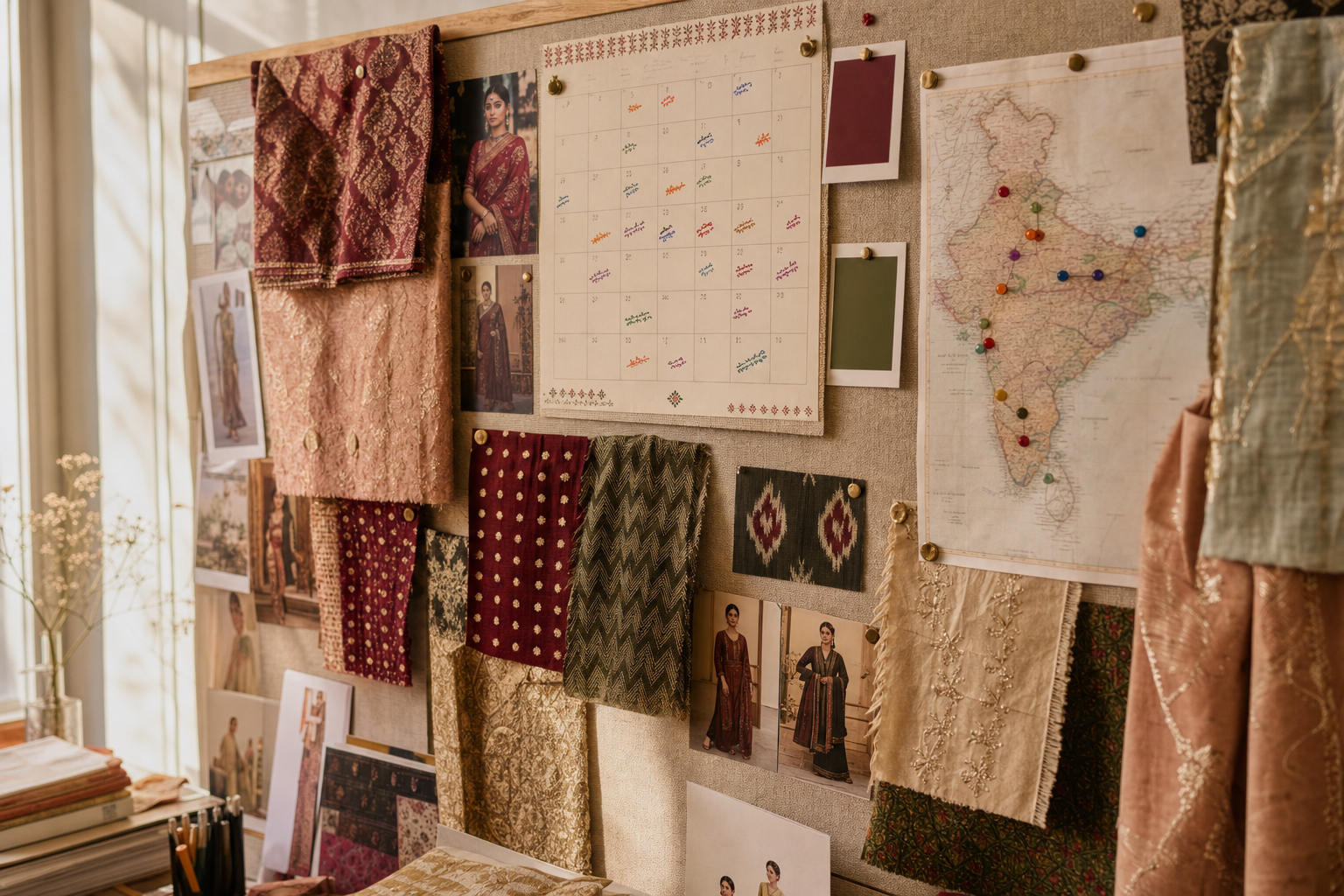
The festive calendar in our engine has forty-two windows. Each window has its own per-category lift, learned from three years of Indian D2C sales data we have processed across the merchants we work with. When the forecast says cobalt anarkali, depth seven hundred units, ship by October 14 — the seven hundred is a calibrated answer to a question of cost, not a hopeful round number.
The depth-of-buy calculation balances stockout cost against holding cost on a per-SKU basis. The buyer sees both numbers, side by side, with a recommended depth and the implied risk on either side of it. If the buyer wants to over-rule and buy a thousand because she has a feeling about cobalt — she can. The model will tell her the implied bet she is taking and what would justify it.
What changes for the buyer
The first change is timing. The festive forecast is alive on the platform from June for an October window. Lead-time visibility is built in — chanderi from MP has its own clock, polyester crepe from Surat has another — and the buyer can see, this week, how many days she has left before each manufacturing window closes. There is no did we miss it? moment in October because the buyer was watching the clock all summer.
The second change is depth. The buyer no longer applies a uniform instinct multiplier. Each festive SKU has its own depth recommendation, sized to the cost geometry of that SKU. The high-margin pieces get loaded; the low-margin pieces get held. Markdown season looks different.
The third change is honesty. Every forecast on the platform has a calibrated prediction interval — an honest bracket that says the model is 80 percent confident the answer lies between these two numbers, and here is its track record on accuracy. When the bracket is wide, the brief says watch, don't load. When it is tight, it says go. The buyer is no longer choosing between a single number and her instinct. She is making a graded decision with full information.
What we will not pretend
We will not pretend that festive forecasting is a solved problem. The Indian D2C market is too lumpy, too event-driven, too dependent on the runway taste-makers, for any model to claim oracle status. What we have built is a model that is honest about its uncertainty, that knows about the calendar as the dominant forcing function it is, and that has the discipline to size depth against cost rather than against feeling.
The Diwali buy that is wrong every year does not have to stay wrong. It just needs a tool that respects the way an Indian buyer actually thinks.
The buyers we work with are doing the work. We are giving them the maths.